DODO
Service Robot.
Autonomous delivery robot for restaurants and indoor service spaces[cite: 11]. Dodo is a self-contained autonomous delivery robot built at Arbotrix for secure, multi-tray transport[cite: 11].
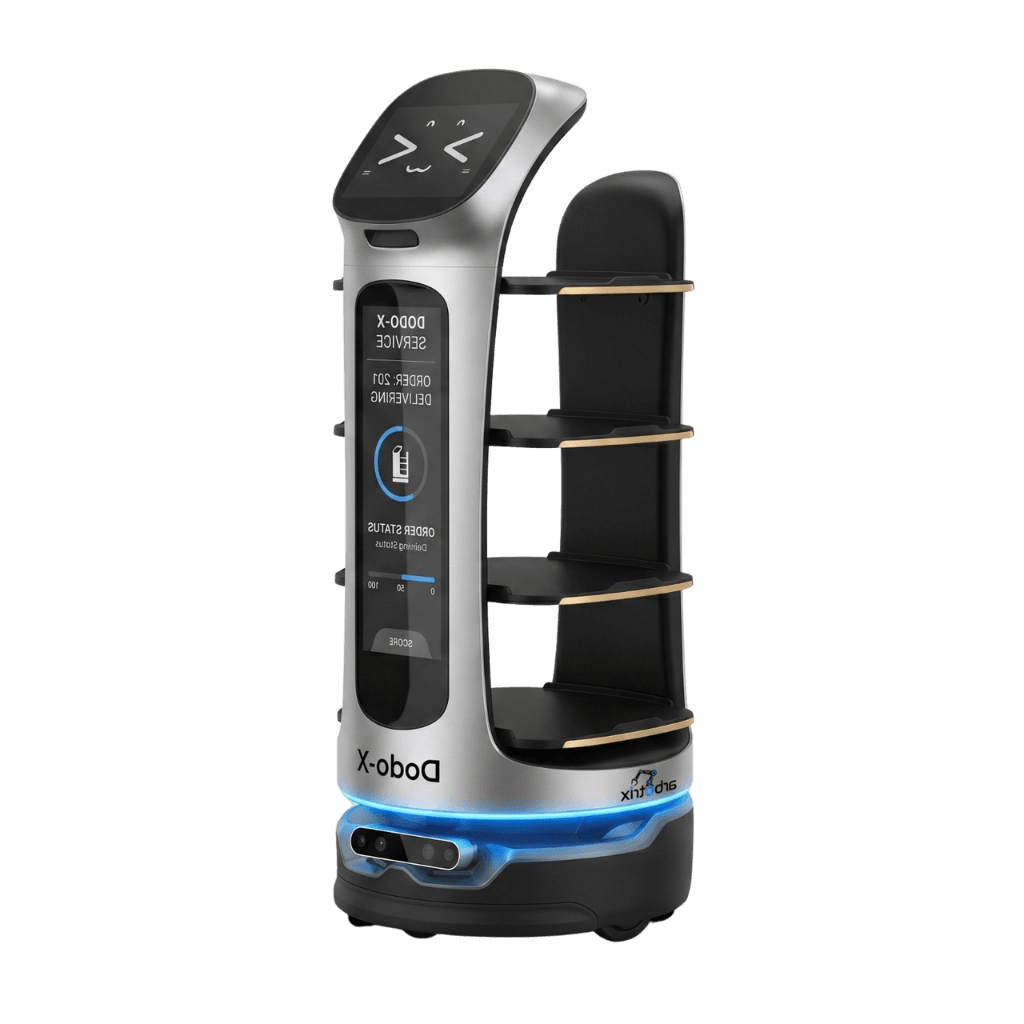
Dodo Overview
Overview
What is Dodo?
Dodo is a self-contained autonomous delivery robot built at Arbotrix for secure, multi-tray transport. It maps its surroundings, plans its own path to each table and avoids people on the way[cite: 10].
The Challenge
In a busy restaurant, staff spend much of their shift walking between the kitchen and tables carrying heavy trays. At peak hours this slows service and tires the team. Imported service robots are costly and hard to repair or customise locally[cite: 10].
Our Approach
We built Dodo end to end in our lab, from the drive system and electronics to the navigation software. It runs on a modern ROS2 stack with LIDAR mapping and on-camera AI, and is designed to be easy to service in Pakistan[cite: 10].
Key Capabilities
Autonomous Navigation
LIDAR SLAM mapping, AMCL localisation and Nav2 path planning to reach each table[cite: 10].
AI Obstacle Detection
OAK-D camera runs spatial object detection on its own chip, so people and objects are seen in 3D[cite: 10].
Multi-Tray Delivery
Four trays carry several orders in one trip from kitchen to tables[cite: 10].
Secure Remote Control
Monitored and controlled over encrypted Tailscale networking with ROS bridge integration[cite: 10].
Live Dashboard
Robot status, map and detections shown live on a tablet dashboard[cite: 10].
Friendly Interface
Expressive face display and an order-status screen that guests understand at a glance[cite: 10].
Engineering Insight
Object detection runs on the OAK-D camera's own chip, keeping the main computer free for navigation and mapping[cite: 10].
Dodo Design & Build
Design & Build
Designed for busy service floors
Dodo combines a compact round body with a tall tray tower, so it can move through narrow aisles between tables while carrying several orders at once[cite: 10].
Design highlights
- 4-tier tray tower for multiple orders per trip[cite: 10]
- Expressive face display that makes guests comfortable[cite: 10]
- Order-status touchscreen showing order number and progress[cite: 10]
- Front depth camera (OAK-D) for 3D obstacle detection[cite: 10]
- 2D LIDAR for mapping and localisation[cite: 10]
- LED light ring so people can see the robot moving[cite: 10]
- Compact round footprint (about 45-50 cm) for tight spaces[cite: 10]
Built for reliability
We wrote a custom USB watchdog that automatically power-cycles the LiDAR if it stops responding, so the robot recovers on its own instead of stopping mid-shift[cite: 10].
How a Delivery Works
Load
Kitchen staff place orders on the trays[cite: 10].
Assign
Staff choose the table from the screen or dashboard[cite: 10].
Navigate
Dodo drives itself to the table, avoiding people and chairs[cite: 10].
Serve & return
Guests pick up their food and Dodo returns to base[cite: 10].
Dodo Technology
Technology Stack
Under the hood
Applications
Where Dodo fits
Restaurants & cafés
Delivering food and collecting empty dishes[cite: 10].
Hotels
Room service and lobby deliveries[cite: 10].
Hospitals & clinics
Moving meals and supplies between wards[cite: 10].
Office cafeterias
Serving staff in large corporate canteens[cite: 10].
Banquets & events
Serving guests during large functions[cite: 10].
Malls & food courts
Delivering orders across busy seating areas[cite: 10].
Ready to deploy Dodo?
Talk to our engineering team about custom payloads, ROS2 integration, and hardware leasing for your facility.